White Bronze Markers
They look almost new after 140 years, and they are not bronze at all. How to recognize a zinc monument, what goes wrong with them, and how to care for one without harm.
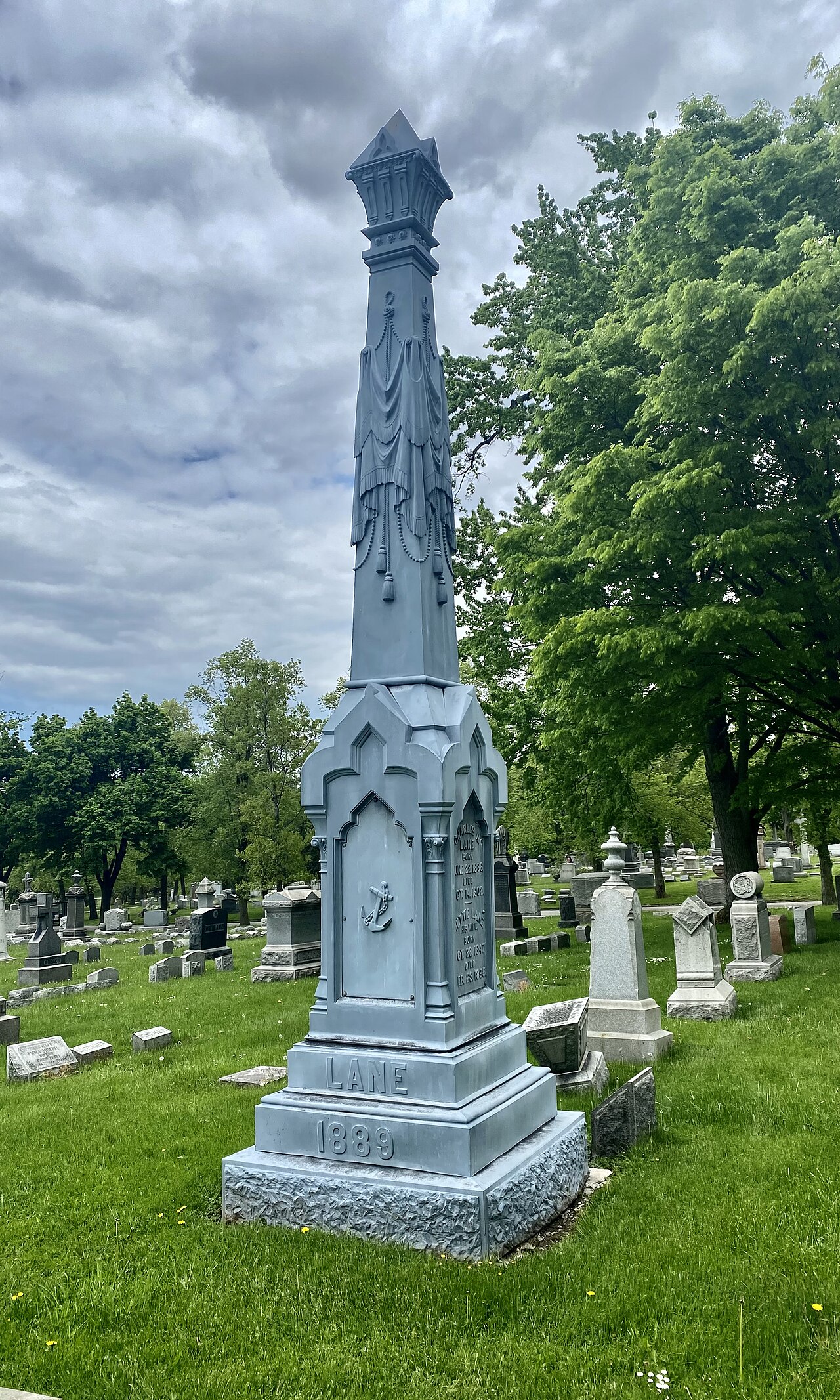
Walk through almost any American cemetery laid out before 1915 and sooner or later you will find a monument that doesn’t look like the others. It is a soft blue-gray, the lettering is as sharp as the day it was made, and there is no lichen on it at all. Knock on it with a knuckle and it rings hollow.
That is a “white bronze” marker. The name was a sales term. The metal is almost pure cast zinc.
A Short History
Zinc monuments were developed in the early 1870s and the rights were soon taken over by the Monumental Bronze Company of Bridgeport, Connecticut, incorporated in 1879. The company was effectively the only American maker. It cast the parts in Bridgeport and finished them at subsidiaries and branches in places such as Chicago, Detroit, Des Moines, New Orleans, Philadelphia and St. Thomas, Ontario.
Nobody walked into a showroom to buy one. Families chose from a printed catalog shown by a traveling agent, and the order was shipped by rail. Zinc markers cost less than carved granite of the same size, came in hundreds of designs, from small tablets to towering Civil War soldiers’ monuments, and could be personalized. Most have removable panels, called tablets, held on by decorative screws, so a family could add a name later by ordering a new panel.
Production of monuments ended around 1914, when the Bridgeport plant was turned over to war work for World War I. The company kept making plaques and panels for years afterward and finally closed in 1939.
How to Recognize One
- Color. An even blue-gray, sometimes with a light chalky bloom. The “white” in the name comes from this pale surface.
- Sound. A light tap with a knuckle gives a hollow, metallic ring.
- Magnet. A magnet will not stick. Zinc is not magnetic, which tells it apart from cast iron.
- Detail. Crisp lettering and ornament that look freshly made, with no lichen or moss on the surface.
- Construction. Panels attached with ornamental screw heads, visible seams where cast sections were joined, and often a foundry mark near the base.
What Goes Wrong
- Creep. Zinc slowly deforms under its own weight. Over a century a tall monument can bulge at the bottom, lean, or settle out of square. This is the most serious long-term problem.
- Cracks and broken joints. Zinc is brittle in cold weather and when struck. Cracks start at corners, joints and the base.
- Missing panels and screws. Tablets fall off or are stolen, and screws work loose or corrode.
- Bad repairs. Concrete poured inside, iron rods, steel screws and copper flashing all cause trouble. Concrete adds weight and holds water; iron and copper set up corrosion where they touch the zinc.
- Impact. Mowers, trimmers, falling limbs and vandals crack the thin metal easily.
Caring for a Zinc Marker
The good news is that zinc needs very little. Its gray surface layer is what protects it. The aim is to keep it clean, keep it standing, and keep harmful repairs away from it.
Do
- Photograph it and record every panel, including the back
- Rinse with plain water and a soft natural-bristle brush if it needs it
- Check that it stands level and that screws and panels are secure
- Keep mowers and trimmers well back; trim around it by hand
- Save any loose pieces and label where they came from
- Call a metals conservator for cracks, leaning or structural repairs
Don’t
- Use stone cleaners, acids, bleach, wire brushes or a pressure washer
- Paint it, wax it or coat it
- Pour concrete inside or fill it with anything
- Use steel, iron or copper screws, rods or patches
- Weld, solder or heat it — heated zinc gives off toxic fumes
- Try to straighten a leaning or bulging monument yourself
Repairs are a job for a conservator. Professionals may replace missing screws with stainless steel or matching zinc, rejoin broken sections with a suitable adhesive, or add a hidden internal support to stop creep. A leaning monument needs its base reset correctly, not propped.
Sources
- Oregon Heritage, Heritage Bulletin 41: care of zinc (white bronze) grave markers.
- National Park Service, Preservation Brief 48: Preserving Grave Markers in Historic Cemeteries.
- ConnecticutHistory.org, history of the Monumental Bronze Company of Bridgeport.
More from Guardian Stone Care: all articles · our free Stone Assessor · the free Ground Explorer.
Guardian Stone Care & Restoration, November 2026.