Iron Grave Markers
From foundry-cast tablets to the hand-forged crosses of the Northern Plains: how to tell what you have, and how to keep it from rusting away.
Iron shows up in old cemeteries in many forms: cast-iron tablets and crosses ordered from a foundry, plot fences and gates, small cast markers set by funeral homes, and crosses hand-forged by local blacksmiths. Iron was strong, cheap and could be shaped into lace-like designs no stonecutter could match. Its weakness is rust.
Cast Iron or Wrought Iron?
The two are made in completely different ways, and it matters for care.
- Cast iron was poured as liquid metal into a sand mold. Look for repeated, identical ornament, mold seams along the edges, and a slightly sandy surface texture. It is hard but brittle: a blow or a freeze can crack it, and it usually breaks cleanly. Foundries sold cast markers, fences and gates by catalog from the mid-1800s on.
- Wrought iron was heated and hammered by a blacksmith. Look for small irregularities, hammer marks, scrolls bent by hand, and parts joined with rivets, collars or forge welds rather than bolts. It bends instead of snapping, and as it rusts it often shows a grainy, wood-like texture.
- Many “wrought iron” fences from the late 1800s on are really mild steel. Care is much the same.
Both are magnetic, which is the quickest way to tell iron from zinc “white bronze” markers.
The Iron Crosses of the Northern Plains
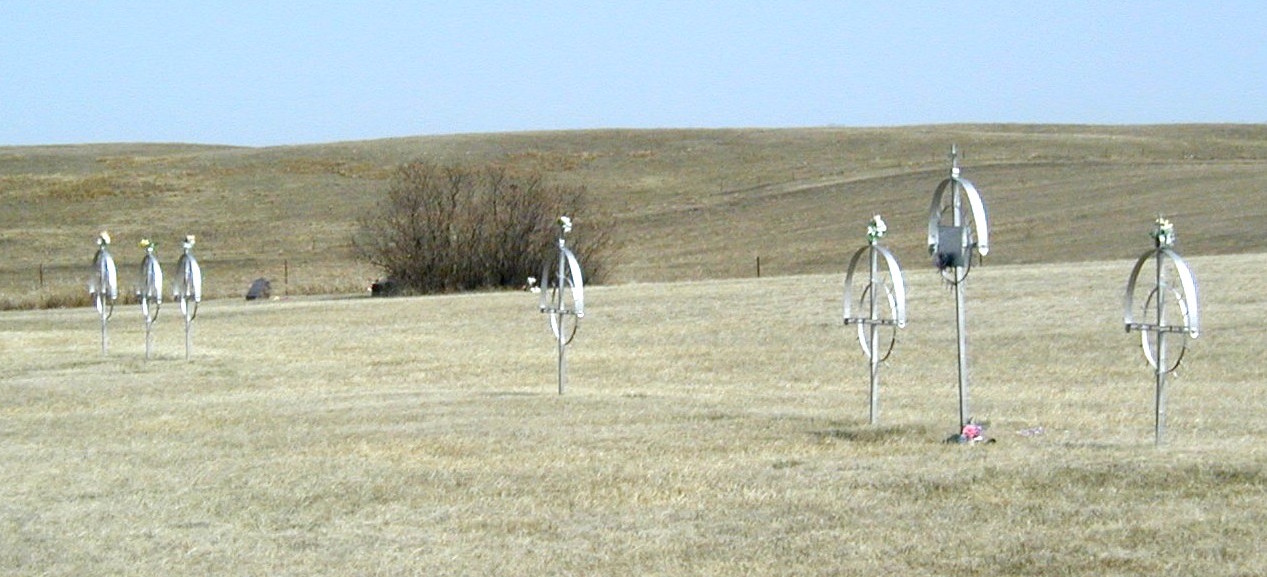
One of the most remarkable groups of iron grave markers in the country stands in the cemeteries of central North Dakota. Blacksmiths among the German-Russian immigrants who settled there forged elaborate crosses from about the 1880s into the 1920s, many in Catholic cemeteries, with sunbursts, hearts, scrolls and small tin nameplates. Each smith had a recognizable style. The crosses were so important that many of these cemetery sites were listed together on the National Register of Historic Places in 1989.
What Goes Wrong
- Rust. Iron can swell to many times its original thickness as it rusts. Rust in a joint or socket pushes parts apart, and an iron pin or post set into stone can crack the stone from the inside.
- Water traps. Hollow castings, joints and the ground line hold water and rust fastest.
- Lost paint. Iron markers and fences were meant to be painted, usually black, white or dark green. Once the paint goes, rust starts.
- Impact and theft. Mowers crack cast iron, and iron fences and gates are stolen for scrap.
- Mixing metals. Copper or brass touching iron speeds corrosion.
Caring for an Iron Marker
Do
- Photograph and record it first, including any nameplate
- Rinse dirt off with water and a soft natural-bristle brush
- Remove loose, flaking rust gently with a hand tool or stiff synthetic brush
- Keep plants, soil and mulch away from the base so it can dry
- Have bare iron primed and painted in a historically suitable color
- Use stainless steel for any replacement pins or fasteners
Don’t
- Use acids, stone cleaners or bleach on iron
- Use grinders, power wire wheels or sandblasting without a professional
- Sand or scrape old paint without testing it for lead
- Weld cast iron unless the welder has done it before — it often cracks
- Patch with copper, brass or ordinary steel
- Pull a stuck post out of stone; it can split the stone
After loose rust is removed, a rust-converting primer (tannin or phosphoric-acid based) followed by a good primer and topcoat is the usual approach. Cracked castings, broken joints and markers that are leaning or set in stone are jobs for a blacksmith or metals conservator who has worked on historic ironwork.
Sources
- National Park Service, Preservation Brief 48: Preserving Grave Markers in Historic Cemeteries.
- National Park Service, Preservation Brief 27: The Maintenance and Repair of Architectural Cast Iron.
- North Dakota State University, Germans from Russia Heritage Collection: wrought-iron cemetery crosses.
More from Guardian Stone Care: all articles · our free Stone Assessor · the free Ground Explorer.
Guardian Stone Care & Restoration, November 2026.